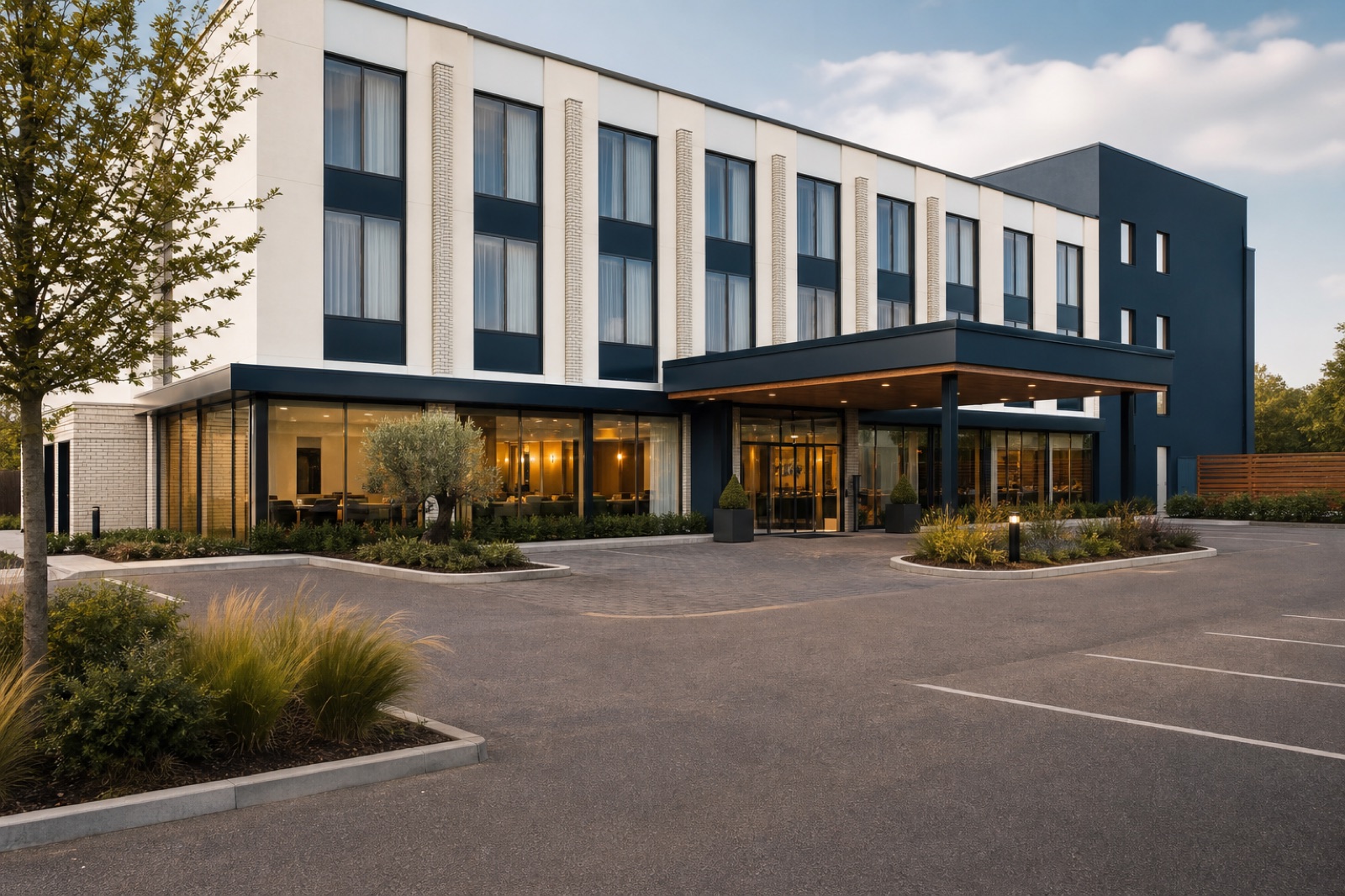
Budget and limited-service hotel finance
We arrange commercial finance for operators, buyers and investors acquiring, refinancing or building budget and limited-service hotels. This is business lending against a trading hotel, not a personal mortgage.

Funding budget hotel
Budget and limited-service hotels, the Premier Inn and Travelodge style of asset, run a lean model: a high room count, a thin service offer, tight cost control and revenue led by RevPAR rather than food, beverage and conference income. For lenders, that simplicity is a virtue. A well-located limited-service hotel with steady occupancy is the most resilient and lender-friendly segment we work in.
When we say budget hotel finance we mean a commercial mortgage, term loan, development facility or bridging line used to buy, build or refinance the hotel as a trading business. The credit decision turns on the going-concern EBITDARM, occupancy, ADR and RevPAR, and the strength of any brand or franchise covenant, not on a borrower's personal income.
Because the operating model is predictable and the cost base is controllable, budget and limited-service assets with a strong covenant can attract keener leverage and pricing than more volatile full-service or resort hotels. The room is the product, the average daily rate and occupancy drive the income, and disciplined payroll and overhead control protect the margin.
We package the trade, the operator story and the numbers so hospitality-experienced lenders can price the risk quickly, and we run the whole market as an arranger rather than approaching a single bank.
What we fund
- Branded budget hotels run under franchise or management agreements
- Independent limited-service and economy hotels
- Roadside and edge-of-town budget hotels
- City-centre limited-service hotels led by RevPAR
- Conversions of offices or retail to limited-service rooms
- Small budget-hotel portfolios held by a single operator
Indicative terms
- Acquisition or term LTVUp to around 65 to 70% of value
- Going-concern basisSized on maintainable EBITDARM
- Term15 to 25 years
- Indicative rateFrom around 7 to 10% per annum
- Development or conversionAround 60 to 65% of cost
- Key testsOccupancy, ADR, RevPAR, covenant, cost control
- RepaymentCapital and interest or part interest only
Indicative only. Terms vary by lender, operator and home and are not an offer of finance.
How we fund budget and limited-service hotels
We fund budget hotels on their going-concern trade. For an acquisition or term refinance we model the maintainable EBITDARM, read it through occupancy, ADR and RevPAR, and place the request with hospitality-experienced lenders on a commercial mortgage or term loan to around 65 to 70% of value, typically over 15 to 25 years at an indicative 7 to 10% per annum. Because the limited-service model is lean and predictable, a hotel with a strong covenant, whether a brand franchise or a proven independent operator, often sees keener leverage than a volatile full-service asset. For new schemes or conversions we arrange development finance to roughly 60 to 65% of cost at an indicative 9 to 12% per annum, with the exit onto a stabilised term loan once the hotel trades to plan. Where the works are time-critical we use bridging at an indicative 0.75 to 1.30% per month. We frame every figure as indicative and never as an offer; the terms a given hotel attracts depend on its accounts, location and covenant.
Lender appetite for budget and limited-service hotels
Budget and limited-service hotels are the most widely banked hotel segment, so appetite is deep and pricing competitive. High-street and challenger banks lend on stabilised limited-service assets with a sound covenant, specialist hospitality lenders fund acquisitions and small portfolios on going-concern EBITDARM, and development-focused funders back conversions and new-build economy schemes. Branded budget hotels with a recognised franchise or management agreement, set against the scale of operators such as Premier Inn with around 850 hotels and Travelodge with around 590, give lenders a covenant story they understand quickly. We are an arranger and introducer with no exclusive tie to any lender, so we match the hotel and the operator to the funder most likely to price it keenly rather than steering every case to one bank.
The budget and limited-service hotel market
The budget segment trades on resilience. Knight Frank and HotStats put regional UK RevPAR at around £98 in Q3 2025, on occupancy of 82.8% and ADR of around £118, while London RevPAR sat at around £233 on 87.5% occupancy, evidence of steady room demand that limited-service operators capture efficiently. UK hotel investment reached £3.01bn year to date in 2025 per Savills, following a record £6.6bn in 2024 per Christie & Co, with regional price per room at around £129,000 against London at around £315,000 per Knight Frank, and a UK average of around £142,000 per Cushman and Wakefield in H1 2025. That liquidity, combined with the predictability of the limited-service model, gives lenders confidence in a well-run budget hotel as both an income asset and a future exit.
Finance that suits this setting
- Hotel acquisition financeThe core route for buying a trading budget hotel or adding to a portfolio.
- Hotel term loansLong-term debt against the going-concern trade of a stabilised limited-service hotel.
- Hotel refinanceRe-prices debt or releases equity once a budget hotel is trading steadily.
- Hotel development financeFunds new-build or conversion of economy and limited-service room stock.
Fund a budget hotel home
A view on fundability within one working day.
What drives a budget hotel's numbers
A budget hotel's value to a lender comes down to going-concern EBITDARM, built from occupancy, average daily rate and RevPAR, then net of a lean, controllable cost base. Knight Frank and HotStats put regional UK RevPAR at around £98 in Q3 2025 on occupancy of 82.8% and ADR of around £118, with London RevPAR at around £233 on 87.5% occupancy and ADR of around £266. The limited-service model strips out food, beverage and conference cost, so the room is the product and disciplined payroll and overhead control protect the margin. A hotel that fills well, holds its rate and runs lean converts those metrics into a dependable EBITDARM, which is what lenders size lending against. We model the maintainable earnings across a full year, not a single strong month, because that is what supports the debt.
Indicative budget hotel leverage and rates
Indicatively we arrange budget and limited-service acquisition or term lending to around 65 to 70% of value, over 15 to 25 years, at around 7 to 10% per annum, sized on the going-concern EBITDARM. A strong covenant, whether a brand franchise set against operators such as Premier Inn with around 850 hotels and Travelodge with around 590, or a proven independent operator, with steady occupancy and disciplined cost control, earns the keener end. Development or conversion of new room stock runs to around 60 to 65% of cost at an indicative 9 to 12% per annum, and bridging for time-critical works at an indicative 0.75 to 1.30% per month. These are market-typical figures, framed as indicative and never as an offer; the terms a given hotel attracts depend on its trade, covenant and location, and we run the market to find them.
Frequently asked questions
How much deposit do I need to buy a budget hotel?
On a going-concern acquisition we typically arrange lending to around 65 to 70% of value, so a deposit of 30 to 35% is a realistic working assumption. The exact figure depends on occupancy, ADR, RevPAR, the operator covenant and the strength of the trading accounts. We size each case individually and present the leverage as indicative, not an offer.
How do lenders estimate the finances of a small budget hotel?
Lenders read a budget hotel through its going-concern EBITDARM, built from occupancy, average daily rate and RevPAR, then net off realistic payroll and overheads. Because the limited-service model is lean, a hotel that fills well and controls cost converts room revenue into a dependable margin, which is the number lenders size lending against rather than personal income.
Are budget hotels easier to finance than full-service hotels?
Generally yes. The limited-service model is predictable, the cost base is controllable and demand is resilient, so budget and limited-service hotels are the most lender-friendly segment. A strong covenant, whether a brand franchise or a proven operator, can attract keener leverage and pricing than a volatile full-service or resort asset.
Can I get a commercial mortgage on a branded budget hotel?
Yes. A commercial mortgage or term loan is the standard route. Lenders price against the going-concern trade and the brand or franchise covenant, lending to around 65 to 70% of value over 15 to 25 years at an indicative 7 to 10% per annum. We run the market to find the keenest fit and present every figure as indicative.
Can finance fund a conversion to a limited-service hotel?
Yes. Where offices or retail are being converted to economy rooms we arrange development finance to around 60 to 65% of cost, or bridging where the works are time-critical, with the exit onto a stabilised term loan once the hotel trades to plan.
Funding a budget hotel home?
Tell us about the home and the operator and we will come back with a view on fundability and likely terms.